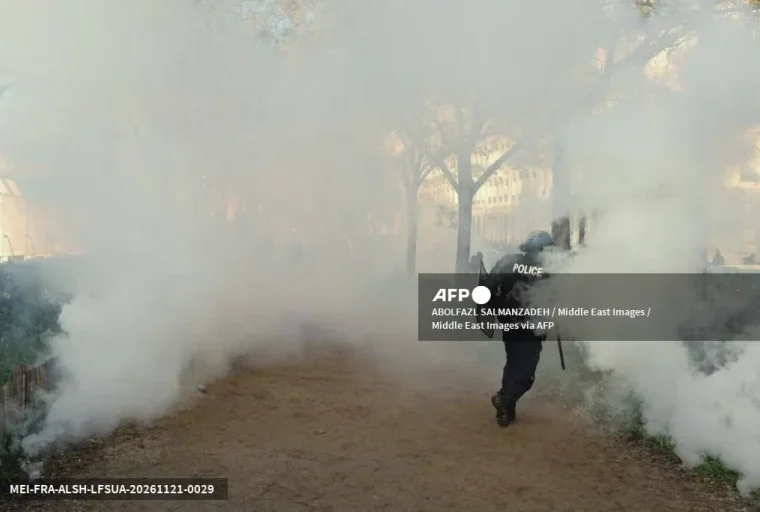
Thousands of women and girls in France have reported menstrual disturbances, severe bleeding and miscarriages after being exposed to tear gas during nationwide protests in October, according to a report by The Guardian.
The British newspaper reported on Friday that feminist collective Lacrymos de Sang had gathered testimonies from more than 9,200 women and girls who said they were exposed to tear gas during the demonstrations.
Of those who responded, 94 per cent reported gynaecological symptoms, including severe uterine cramps, unusually heavy bleeding and missed periods.
Some women said they experienced bleeding that lasted several weeks, while others described pain so intense that they were unable to walk or go to work.
The collective also recorded accounts of pregnancy loss. Among 47 pregnant respondents who reported exposure to tear gas, 15 said they had suffered miscarriages, while 17 reported contractions, pain or bleeding. Two of them said they had sought emergency gynaecological treatment.
The complaints followed the reported use of about 22,000 tear gas grenades by French police during the October 17 protests, according to figures cited by The Guardian from a parliamentary hearing.
One of the women who shared her experience, 46-year-old Naïma Di Piero, said she began bleeding heavily two days after exposure, despite having used contraceptive pills for three years to suppress her menstrual cycle.
She told the newspaper that the bleeding continued for 10 days and came with blood clots and severe cramps that affected her sleep.
“I’ve never been so tired. I wear a headscarf because I’m losing my hair, too,” she said.
Another respondent, who was seven months pregnant, said she lost her baby after being exposed to tear gas while walking her dog.
According to the collective, girls and women under 20 appeared to be particularly affected, reporting more symptoms and experiencing them sooner than older respondents.
However, researchers have warned that scientific evidence directly linking tear gas exposure to reproductive health complications remains limited.
Solène Rougeux, a doctoral researcher in neuroendocrinology who analysed the testimonies, said stress could interfere with menstrual cycles but would not explain heavy bleeding among women who had gone through menopause or account for reported miscarriages.
An obstetrician-gynaecologist at Paris’s Port-Royal maternity hospital, Dr Maha Eid, said she treated patients who experienced severe menstrual pain and flare-ups of endometriosis after the protests.
Eid said more research was necessary, although exposure to CS gas, a chemical irritant commonly used in tear gas, could potentially activate receptors in the uterine lining and trigger contractions. She noted that this could pose a risk during early pregnancy.
The French Interior Ministry, however, said government studies conducted in 2021 and 2022 found no evidence of specific health risks associated with tear gas exposure. The findings of the studies have not been made public.
A ministry spokesperson told The Guardian that possible effects from substances produced when CS gas breaks down in the body had been suggested but were yet to be scientifically established.
The report also highlighted similar complaints of menstrual disturbances following the use of tear gas during protests in Hong Kong in 2019 and the United States in 2020.
Activists and health researchers have called for further investigations into the reported symptoms, particularly among children and teenagers exposed during the demonstrations.
Eva-Luna Tholance, founder of Lacrymos de Sang, said the long-term reproductive health consequences of repeated exposure to tear gas remained unknown.
Meanwhile, Rohini Haar, a doctor with Physicians for Human Rights, said tear gas was designed to cause enough pain to force people out of a crowd. She added that its use also had implications for people’s rights to free speech and peaceful assembly.