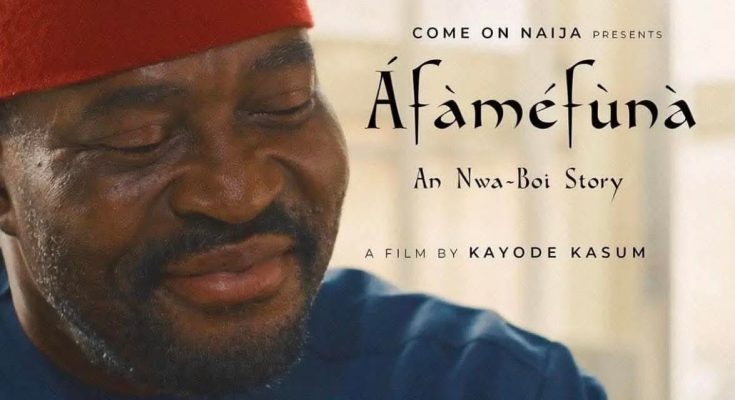
The recently released Nollywood film Afamefuna has earned praise for its strong storytelling and stellar performances. However, one detail in the script has sparked debate among historians and keen observers of Nigeria’s past.
In the movie, a character played by veteran actor Kanayo O. Kanayo claims that after the Nigerian Civil War, all Igbos were given only £20, regardless of the amount they had deposited in Nigerian banks. While the line makes for powerful cinema, experts insist it is misleading and risks distorting an important chapter of Nigeria’s history.
The Origins of the £20 Controversy
The confusion stems from the introduction of the Biafran Pound in January 1968, when the secessionist government declared the Nigerian Pound illegal in its territory. The Federal Military Government under General Yakubu Gowon immediately rejected the new currency, urging citizens not to accept it.
As a result, many Biafrans withdrew their savings in Nigerian Pounds and stored them privately, while others were left holding the now-isolated Biafran currency, which had no international recognition and could not be exchanged abroad.
When the war ended in 1970, the question arose: what should become of the Biafran Pound? Unlike Nigeria’s legal tender, the Biafran currency was not backed by the Central Bank or any reserves.
Awolowo’s Intervention
At the time, Chief Obafemi Awolowo, then Federal Commissioner for Finance, devised a compromise. In what has been described as a personal initiative, he ordered that all former Biafrans with accounts that had become unverifiable or were held in Biafran Pounds would receive a flat £20 payment.
Contrary to the sweeping claim in Afamefuna, this was not a blanket rule applied to every Igbo person. Those who could prove their account balances in Nigerian Pounds such as Senator Arthur Nzeribe and Chief Alex Ekwueme were able to recover their full deposits. Even the father of John Nwodo reportedly regained his entire fortune.
Awolowo also ensured that the East Central State received all its allocations from the Federation Account for the duration of the war, which had been safely invested. This was publicly acknowledged by S.G. Ikoku, then Commissioner for Economic Development, in Daily Times of May 22, 1971.
A Gift, Not a Confiscation
Historians stress that the £20 payment was not a punitive confiscation of Igbo wealth, but rather an emergency relief measure. “It was a gesture of goodwill in a post-war atmosphere, not an official declaration that all Igbo assets were worth only £20,” one analyst explained.
For context, the outcome compares favorably to the American Civil War, where Confederate currency was rendered completely worthless after the Union’s victory in 1865, with no compensation offered.
The Risk of Rewriting History
While films like Afamefuna play an important role in cultural memory, scholars caution that factual inaccuracies can harden into accepted truths. As Nigeria continues to reflect on its civil war history, experts insist that public discourse must be guided by evidence rather than myth.
“Cinema has the power to shape how future generations understand the past,” one historian warned. “But when art crosses into history, it carries a responsibility to be accurate.”


