
How Over-Engineering in DevOps Is Undermining Agility
By Cynthia Duru
In 2024, global enterprise investment in DevOps is projected to surpass $28.5 billion, driven by an unrelenting push toward cloud-native infrastructure, hyperautomation, and security-integrated delivery pipelines. The rationale is clear: faster deployment cycles, tighter feedback loops, and bulletproof system reliability.
DevOps, once the antidote to delivery bottlenecks, has become burdened by its own success. The pipelines that promised simplification have evolved into sophisticated, fragmented architecture; impressive in theory, fragile in practice. But for all the funding pouring in, there’s a rising counter-effect; Some teams are not really accelerating, they’re slowing down.
The primary culprit is Operational complexity.
DevOps was born to simplify software delivery. Today, many pipelines are engineering marvels that few can operate, let alone maintain.
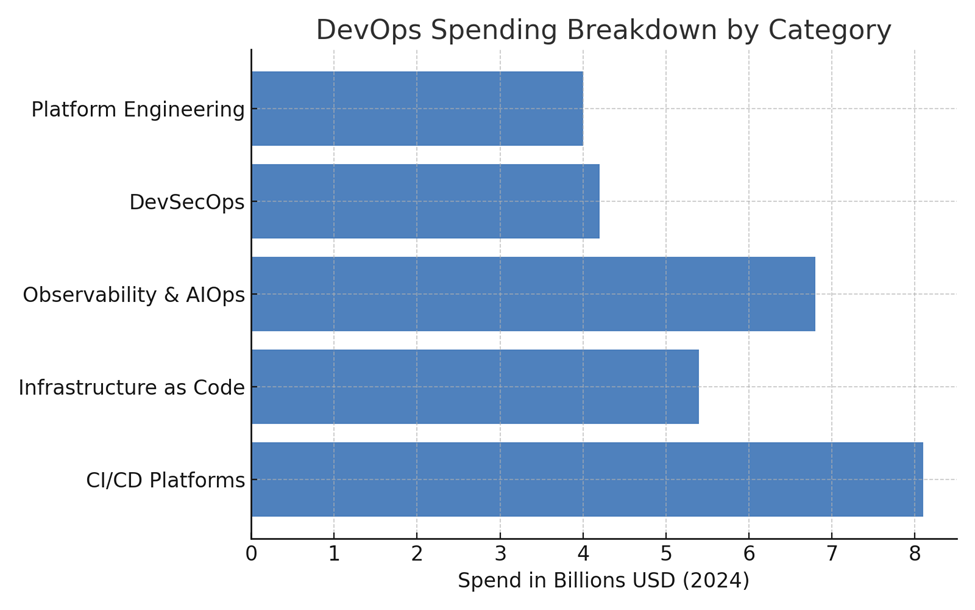
According to Gartner and IDC projections, the five primary categories where DevOps dollars are flowing look like this:
DevOps Spending Breakdown
(Source: IDC, 2024)
- CI/CD Platforms – $8.1B
- Infrastructure as Code – $5.4B
- Observability & AIOps – $6.8B
- DevSecOps – $4.2B
- Platform Engineering – $4.0B
DevOps Spending Breakdown Chart
While these tools offer unprecedented power, teams are increasingly facing what can only be described as Pipeline Paralysis, a condition where the complexity of the DevOps ecosystem outweighs the value it delivers. I’ll break this down:
1. CI/CD Pipeline Bloat
The 2024 State of DevOps Report by Puppet reveals a telling trend: 39% of enterprises now rely on 10 or more tools within their CI/CD toolchain. What began as a modular approach to software delivery, leveraging specialized tools for source control, testing, artifact storage, environment management, and deployment,has evolved into toolchain sprawl.
While each tool is adopted with the promise of enhanced visibility, control, or automation, the reality is often less elegant. Instead of streamlined pipelines, organisations are stitching together fragile chains of integrations, each with its own syntax, state, secrets, and failure modes.
The result in some cases is Redundant validations across tools that don’t communicate cleanly, brittle handoffs between stages that depend on tightly-coupled logic or custom glue scripts and a growing dependence on deeply-nested YAML configurations, which obscure behavior and defy troubleshooting under time pressure
2. Infrastructure as Code: From Standardization to Obfuscation
When Terraform, Pulumi, and similar tools first gained traction, they revolutionized the way teams approached infrastructure,offering repeatable, declarative provisioning across cloud environments. IaC promised consistency, traceability, and speed. In many cases, it delivered.
But as scale and ambition grew, so did the complexity of the infrastructure codebases. What began as modular, manageable stacks have evolved into sprawling forests of deeply nested modules, dynamic logic branches, and environment-specific overrides. The result? A paradox: reproducibility on paper, opacity in practice.
In production environments today, even minor changes can require tracing a web of interdependencies, versioned modules, and variable interpolations spanning multiple repositories. The developer experience has eroded from one of clarity to one of reverse-engineering.
HashiCorp’s 2024 telemetry data paints a clear picture of this systemic friction:
- 62% of teams report challenges with reusing IaC modules, particularly across teams or lines of business. Misalignment in input/output contracts and inconsistent module design patterns contribute to fragmentation.
- 46% of organizations experience persistent environment drift, even with version-controlled code. Reasons include manual hotfixes, misaligned state files, inconsistent provider configurations, and lack of robust drift detection tooling.
As a result the implications are significant, reports of onboarding delays, new engineers face steep learning curves just to understand the infrastructure landscape. Rollback failures due to Inconsistent states or conditional logic can cause rollbacks to misfire or worse, corrupt environments, auditing nightmares, such that dynamic constructs like count, for_each, and ternary logic make compliance validation and security reviews exponentially harder.
In summary, Infrastructure as Code has become a double-edged sword. Without strong governance, documentation, and architectural discipline, the very abstractions designed to empower developers end up disempowering teams, locking knowledge into the heads of a few senior engineers, and turning every deployment into a potential fire drill.
3. Observability Overload
The rule was “you can’t fix what you can’t measure.” But now, we’re measuring everything. A 2024 Datadog study showed only 37% of triggered alerts led to actionable outcomes. That’s a signal-to-noise ratio many teams can’t afford.
The Cost of Complexity: A Downward Curve
Organizational agility is being choked by DevOps complexity. Every new layer,tool, rule, or abstraction,adds drag to innovation velocity.
Complexity vs. Agility Curve
(Source: Internal DevOps Studies, 2024)
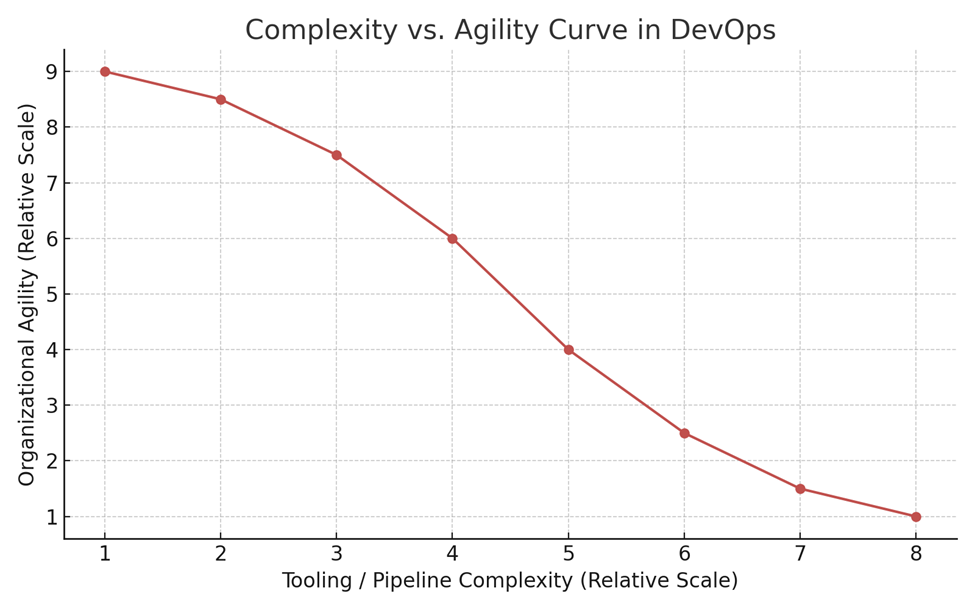
As complexity grows, agility doesn’t just flatten,it collapses. Time-to-market suffers, onboarding slows, and the feedback loop that DevOps was built to speed up becomes muddled with friction.
How to Engineer for Clarity, Not Clutter
So what’s the solution? Not less DevOps but smarter DevOps. A few shifts can help teams find the sweet spot between automation and agility:
- Platform Thinking – Abstract complex workflows into developer-friendly platforms with self-service provisioning and clear interfaces.
- Just Enough Automation – Stop scripting every edge case. Focus on what moves the business forward.
- Measure Pipeline Health – Track flakiness, MTTR, change failure rates, and deployment frequency.
- IaC Governance – Use tools like tflint, checkov, and mandatory module registries.
- Toolchain Rationalization – Run internal audits quarterly. If a tool isn’t delivering clear ROI, retire it.
The Mindset Shift: Simplicity Is a Feature
In an era where delivery speed is everything, the DevOps arms race can be tempting. But complexity isn’t a badge of honor,it’s a silent tax on your engineering velocity.
The most elite teams in 2025 won’t be the ones with the longest pipelines. They’ll be the ones with the clearest paths to production.
By engineering for simplicity, you don’t just reduce costs,you create space for innovation, speed, and scale.
Let’s stop building beautiful machines that no one knows how to drive.


