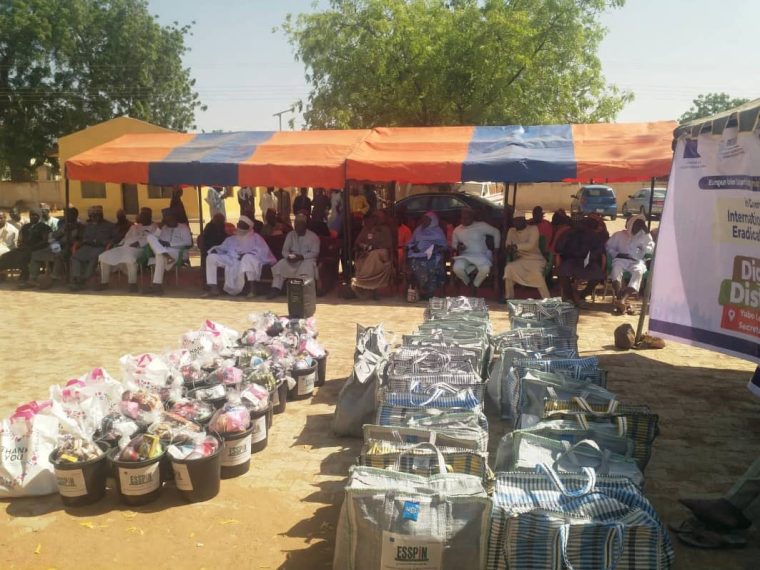
Displaced people sheltering in Yabo Local Government Area of Sokoto State are asking the government and aid groups for permanent housing and help making a living. They say they can barely feed their families. Persistent bandit attacks drove them from their villages, and they’ve lost their farms and other sources of income. They spoke on Friday at the Yabo Local Government Secretariat, during a distribution of dignity kits and other relief items by ActionAid Nigeria, supported by the European Union. The event marked the International Day for the Eradication of Poverty, whose theme was “United for Peace and Human Rights: Safe Homes for All.”
Mukhtar Umar, speaking for the displaced, said families are struggling in their host communities because farming, their main income, is out of reach. “Before now, we used to farm, but where we are now, we cannot do that. Our farms have been taken over by bandits, so we are desperately in need of help,” he said. He thanked the government and aid groups for what they’ve received but said decent housing and regular food are still the biggest problems, and asked for lasting support that lets families rebuild. Modi Tuita, another beneficiary, called their situation difficult and urged the government to do more, and Hafsat Muhammad, speaking for the displaced women, asked for decent accommodation.
ActionAid’s Deputy Country Director, Suwaiba Muhammad Dankabo, said the event was about more than handing out supplies. “It is also to advocate that local, state and federal governments consider safe housing for persons who have been displaced from their homes,” she said. She added that displaced people need continued access to education, healthcare, security and other basic services wherever they’ve taken shelter. The dignity kits, which include sanitary pads, were designed around needs the beneficiaries themselves named, especially women. ActionAid aims to reach 300 people, with 100 getting items in the first round. It also runs a three-year partnership with the Sokoto State Government under an EU-supported social protection programme, which includes pushing for a working social register so the government can identify displaced and poor people and plan for them. That’s operating in two local government areas now, and expanding it depends on funding and meeting set objectives.
The local council described what it has done. Vice Chairman Usman Na’Allah said it has provided housing, food and medicine. At one point, about 2,300 people arrived from villages in neighboring Shagari Local Government Area, and some were put up in government-owned properties rent-free. “Some of them were accommodated in government properties without collecting a kobo,” he said. The council has also asked residents to take in displaced families where they can, and the chairman keeps supplying food and medical help. He asked beneficiaries not to sell the relief items, and said he hopes lasting peace will let people go home.
Other speakers raised related points. Dahiru Ayuba, representing the Senior Special Assistant on Disability Matters, called for including people with disabilities in humanitarian work across the state’s 23 local government areas, and asked the Conditional Cash Transfer programme to reserve at least five per cent of its places for them. Ibrahim Abubakar of the programme said more than 80,000 people have benefited statewide, including about 9,000 in five local government areas, Yabo among them, in recent payments. He added that the state government is building houses for displaced people in some local government areas and plans to extend that to others.