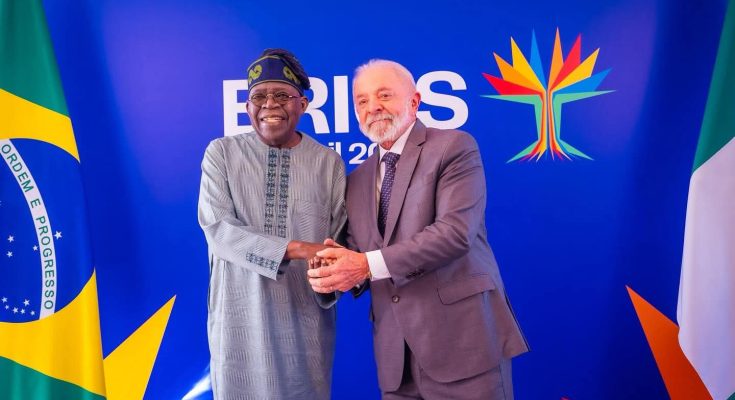
Brasília, Brazil President Bola Ahmed Tinubu on Monday arrived in Brasília, the Brazilian capital, to begin a State Visit aimed at deepening Nigeria’s bilateral relations with Latin America’s largest economy.
The President, who flew in from Los Angeles, United States, was received at the Brasília Air Base by senior Brazilian government officials, including Ambassador Carlos Sérgio Sobral Duarte, Secretary for Africa and the Middle East, and Ambassador Carlos José Areias Moreno Garcete, Brazil’s envoy to Nigeria.
Nigeria’s Minister of State for Foreign Affairs, Bianca Ojukwu, joined other top government officials and private sector representatives at the reception before accompanying the President to his hotel.
An official welcoming ceremony with full military honours is scheduled to take place Monday at the Planalto Palace, where President Tinubu will be hosted by his Brazilian counterpart, President Luiz Inácio Lula da Silva. The two leaders are expected to hold a private meeting, followed by expanded bilateral talks, the signing of key Memoranda of Understanding (MoUs), and a joint press briefing.
During the visit, President Tinubu will also meet with the leadership of Brazil’s Senate, Chamber of Deputies, and Supreme Federal Court, as well as attend the Nigeria-Brazil Business Forum in Brasília.
Strengthening Longstanding Ties
Nigeria and Brazil have enjoyed cordial diplomatic relations since the early 1960s. Brazil was the only Latin American country to participate in Nigeria’s independence celebrations in 1960, while Nigeria established its embassy in Brasília in 1966.
Since assuming office in May 2023, President Tinubu has pursued closer cooperation with Brazil. He attended the BRICS Leaders’ Summit in Rio de Janeiro in July 2025, as well as the G20 Summit in November 2024, at President Lula’s invitation.
High-level visits between both nations have accelerated in recent months. Brazilian Vice President Geraldo Alckmin and his wife, Maria Lúcia Alckmin, visited Abuja in June for the Second Session of the Mechanism for Strategic Dialogue, while Nigeria’s Foreign Minister, Ambassador Yusuf Maitama Tuggar, participated in the BRICS Foreign Ministers’ Summit in April 2025.
The Strategic Dialogue framework, established in 2013, continues to drive cooperation across sectors including agriculture, trade, energy, defence, and education. Its second session in Abuja earlier this year yielded seven new MoUs, ranging from defence and counter-narcotics to livestock development and tourism.
Focus on Food Security and Agriculture
Brazil has emerged as a key partner in Nigeria’s food security drive. The landmark $2.5 billion JBS investment, signed at the 2024 G20 Summit, seeks to bolster local agricultural production and create thousands of jobs for Nigerian youth.
Similarly, the Green Imperative Programme (GIP), a $1.1 billion mechanisation initiative launched in 2019, is progressing, with plans to deliver 10,000 tractors and 50,000 units of farm equipment for assembly in Nigeria.
President Tinubu’s latest visit, observers say, signals Abuja’s determination to leverage Brazil’s agricultural and industrial expertise to boost Nigeria’s economic growth and regional influence.

